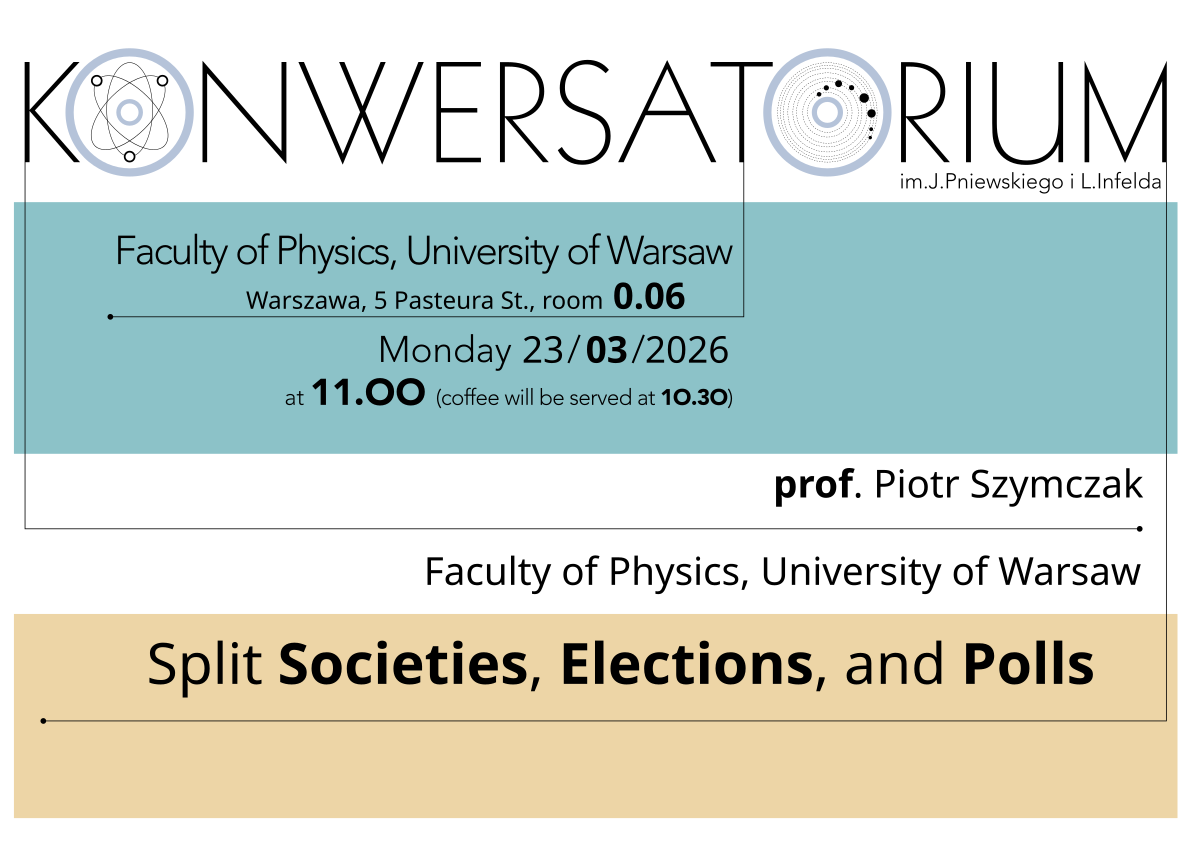




Jerzy Pniewski and Leopold Infeld Colloquium
2026-03-16
The Jerzy Pniewski and Leopold Infeld Colloquium of the Faculty of Physics will be held in room 0.06 on Monday, March 23, at 11:00 AM.
The lecture entitled:
"Split Societies, Elections, and Polls"
will be delivered by:
prof. Piotr Szymczak, Faculty of Physics, Univeristy of Warsaw.
In many cases, voters must choose between two options. It turns out that this situation can be described surprisingly well using a model inspired by the Ising model, which is used in condensed matter physics to describe magnetic interactions between neighboring spins.
The lecture will be held in English.
Before the Colloquium, from 10.30 AM, please join us for informaldiscussions over coffee and cakes in the lobby outside room 0.06.
The dates of the Colloquium in the summer semester 2005/2026 are asfollows:
March 23
April 27
May 25
June 8
With best regards,
Barbara Badełek
Jan Chwedeńczuk
Jan Suffczyński
Abstract:
"Split Societies, Elections, and Polls"
prof. Piotr Szymczak, Faculty of Physics, Univeristy of Warsaw.In modern democracies, the outcomes of elections and referendums are often strikingly close to evenly split. To explain this phenomenon, we propose a simple model of binary voting inspired by the Ising model. Voters are represented as binary spins, with ferromagnetic coupling between neighbors and an additional weak antiferromagnetic coupling to aggregated opinion polls. The model exhibits a distinct split society phase, whose features resemble those observed in real-world elections: the electorate spontaneously divides into two spatially coherent domains with opposing views; overall support hovers around 50/50; and the interface between domains tends to align with geographic or historical boundaries—such as city edges, natural barriers, or former national borders—where neighbor coupling is weaker. We analyze the physical properties of this phase and identify the conditions under which it emerges. By comparing the model with empirical results from binary elections in various countries, we estimate the relevant parameters governing system behavior.
Finally, we examine an alternative coupling mechanism to opinion polls based on self-regulated voter engagement. In this variant, supporters of the leading candidate become less active and less likely to persuade others, while those backing the trailing candidate become increasingly mobilized—tending to equalize public support over time. This mechanism also introduces feedback from polling and can stabilize the system near a 50/50 equilibrium. From a physics perspective, it corresponds to a non-reversible Ising-like model with dynamically evolving couplings.