



New MAB Center – QLAB
2026-02-10
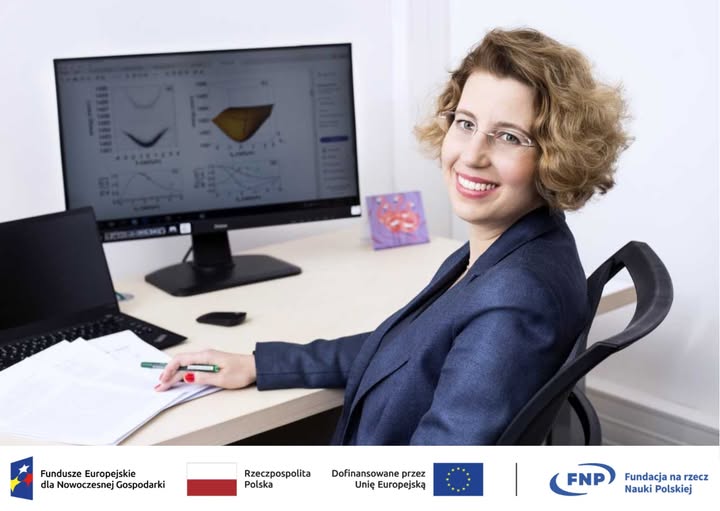
The project Center for Hybrid Quantum–Classical Information Technologies (QLAB) has been selected for funding under the International Research Agendas (MAB) competition, organized by the Foundation for Polish Science as part of the European Funds for a Modern Economy (FENG) program. The project has received funding of PLN 30 million. The new research unit will be headed by dr hab. Magdalena Stobińska-Moretto, professor of the University of Warsaw.
Implemented in cooperation with scientists from Sorbonne University, the project will include research on secure quantum networks and energy-efficient artificial intelligence algorithms, among other topics. The new center of excellence will be led by Prof. Magdalena Stobińska-Moretto, who will join the academic staff of the Faculty of Physics at the University of Warsaw in March 2026.
Prof. Magdalena Stobińska-Moretto is a graduate of the Faculty of Physics at the University of Warsaw. In 2008, she was awarded an Alexander von Humboldt Fellowship at the Max Planck Research Group in Erlangen (Germany). Subsequently, from 2008 to 2012, she worked at the Max Planck Institute for the Science of Light and at Friedrich-Alexander University Erlangen-Nuremberg. From January to April 2017, she was a visiting professor at the Clarendon Laboratory, University of Oxford. She later founded the Quantum Technologies Research Group "QCAT" focusing on the development of new protocols for hybrid technologies such as quantum-enhanced communication and quantum-enhanced computing. She also coordinated the international AppQInfo program under MSCA-ITN (Marie Skłodowska-Curie Innovative Training Networks).
“QLAB is a milestone in building a strong, internationally recognized center for quantum technology research at the University of Warsaw. Our goal is not only to conduct excellent scientific research, but also to develop solutions ready for application in the economy and to strengthen scientific cooperation with leading international partners,” says Prof. Magdalena Stobińska-Moretto.
The project will involve both fundamental research and development work carried out in four interdisciplinary research groups. The teams will focus on key areas: secure quantum networks, energy-efficient artificial intelligence algorithms, ultra-sensitive methods of metrology and imaging, and hybrid technologies integrating quantum and classical systems. The research will be conducted with potential industrial applications in mind, including telecommunications, cybersecurity, medicine, and space technologies. As part of the project, specialized research equipment will be purchased to expand the existing laboratories of the Faculty of Physics at the University of Warsaw, including the Quantum Imaging Laboratory and the Quantum Photonics Laboratory.
