



Intelligent Quantum Sensor with Resistance to Losses
2026-11-12
Researchers from the Faculty of Physics at the University of Warsaw (UW) and the Center for Optical Quantum Technologies at the University of Warsaw’s Center for New Technologies (CeNT UW) have developed a method for ultra-sensitive microwave sensing. Using cold, strongly interacting Rydberg atoms as a microwave detector, the researchers observed that carefully engineered interactions between the atoms make the atomic state resistant to loss. As a result, the measurement provided three times more information about the field under study (measured in terms of so-called Fisher information) than a corresponding measurement without interactions. The research results were published in the prestigious journal Nature Communications.
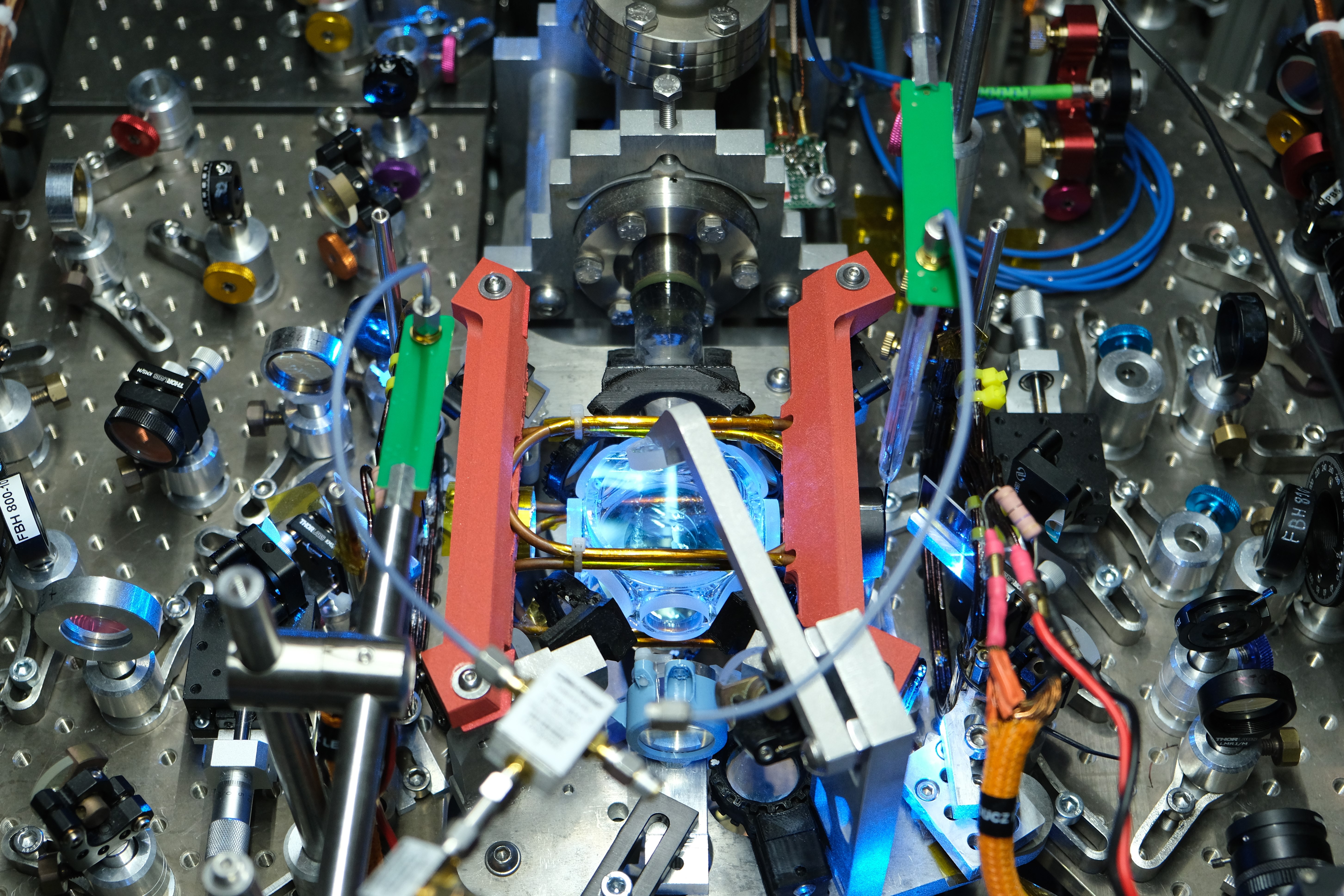
Atomic Microwave Detectors
Precise detection of weak microwave fields is crucial for the development of quantum technologies, including communication methods and metrology. For example, current quantum computers based on superconducting junctions use microwave photons to store information. Detectors based on Rydberg atoms represent a promising direction for the development of electromagnetic detection technology. Thanks to their extraordinary sensitivity to microwave fields, such detectors enable precise measurements without the need for calibration. At the same time, their low noise level even allows for the detection of thermal radiation from the surrounding apparatus.
Very Large Atoms
Rydberg atoms (named after the Swedish scientist Johannes Rydberg) are atoms in which one electron, after being illuminated by carefully tuned lasers, has been excited to a very high-energy state—that is, very far from the nucleus (in physics terms: with a very high principal quantum number). As a result, these atoms become very large (they can increase in size by as much as a thousand times compared to their ground state), which makes them extremely sensitive to external electric fields. At the same time, due to their size, these atoms are characterized by strong mutual interactions, similar to those observed in large gas molecules.
Losses That Can Be Mitigated
Every real-world measurement involves losses. Some of the information about the parameter of interest contained in the signal under investigation may be lost during state preparation, its evolution, or the detection process itself. In a typical system, an increase in losses therefore leads to a decrease in measurement precision. A key element of the discovery turned out to be the surprising behavior of atoms under the influence of interactions. Researchers from the Quantum-Optical Devices Laboratory at the Center for Quantum Optical Technologies CeNT UW (Stanisław Kurzyna, MSc, Bartosz Niewelt, MSc, Prof. Michał Parniak, Prof. Wojciech Wasilewski, Dr. Mateusz Mazelanik), conducting research as part of CeNT UW scientific projects (most of whom are also affiliated with the Faculty of Physics UW), demonstrated that the effects of measurement losses—previously considered an insurmountable barrier—can be substantially mitigated by properly preparing the atoms before the measurement. Losses still invariably reduce sensitivity and are by no means beneficial—but the proposed protocol allows them to be counteracted. It turns out that the interaction between Rydberg atoms, which is itself lossy, transforms their state in such a way that subsequent losses during detection result in significantly less information being lost about the measured field. In collaboration with an expert in the field of estimation from the Faculty of Physics UW, Prof. Rafał Demkowicz-Dobrzański, a theory was developed to explain this surprising behavior. Combining this theory with innovative optimization methods developed at the University of Warsaw made it possible to confirm and more accurately describe the observed effect.
Information About the Measured Field
To assess the accuracy of the measurement, the researchers used a quantity known as Fisher information. It allows us to determine how much information about the parameter of interest—in this case, the microwave field strength—we can obtain using a specific measurement method. To put it simply, it is a measure of the “sharpness” of our knowledge about the measured quantity: the greater the Fisher information, the smaller the uncertainty in the estimation of that parameter can be, which follows from a fundamental mathematical constraint known as the Cramér–Rao inequality.
In the experiment, the measured Fisher information for a system employing Rydberg atom interactions was three times greater than in the corresponding measurement without interactions. This result shows that interactions between excitations can be used to increase the amount of information obtained from a measurement even in the presence of significant losses.The results demonstrate a new way to utilize interactions between Rydberg atoms in the detection of microwave fields. The combination of high sensitivity to electric fields with controlled interactions between atoms allows for the construction of sensors in which measurement losses limit the information much less than in typical methods. The resulting sensor uses Rydberg atoms not only to detect fields, but also to process information. It thus represents an important step toward a new generation of intelligent quantum sensors capable of processing information. Ultimately, such devices could harness the capabilities of quantum computing to achieve unprecedented sensitivity.

The "Quantum Optical Technologies" (FENG.02.01-IP.05-0017/23) project is carried out within the Measure 2.1 International Research Agendas programme of the Foundation for Polish Science co-financed by the European Union under the European Funds for Smart Economy 2021-2027 (FENG).
Faculty of Physics at the University of Warsaw
Physics and astronomy at the University of Warsaw appeared in 1816 as part of the then Faculty of Philosophy. In 1825, the Astronomical Observatory was established. Currently, the Faculty of Physics at the University of Warsaw consists of the following institutes: Experimental Physics, Theoretical Physics, Geophysics, the Department of Mathematical Methods in Physics. The research covers almost all areas of modern physics on scales from quantum to cosmological. The Faculty's research and teaching staff consists of over 250 academic teachers. About 1350 students and over 150 doctoral students study at the Faculty of Physics UW. The University of Warsaw is among the 200 best universities in the world, educating in the field of physics according to Shanghai’s Global Ranking of Academic Subjects.
SCIENTIFIC PUBLICATION:
Stanisław Kurzyna, Bartosz Niewelt, Mateusz Mazelanik, Wojciech Wasilewski, Rafał Demkowicz-Dobrzański & Michał Parniak, Microwave-field quantum metrology with inherent robustness against detection losses enabled by Rydberg interactions, Nat Commun 17, 9013 (2026),
https://doi.org/10.1038/s41467-026-76016-2
CONTACT:
Dr. hab. Michał Parniak, Professor of the University of Warsaw
Center for Optical Quantum Technologies at the University of Warsaw’s Center for New Technologies and Faculty of Physics, University of Warsaw
m.parniak@cent.uw.edu.pl
phone ++48 225543786
RELATED WEBSITES WWW:
https://www.qodl.eu/
Website of the Quantum Optical Devices Laboratory
http://qot.cent.uw.edu.pl/
Website of the Centre for Quantum Optical Technologies QOT UW
https://www.fuw.edu.pl
Website of the Faculty of Physics, University of Warsaw
https://www.fuw.edu.pl/press-releases.html
Press service of the Faculty of Physics, University of Warsaw
GRAPHIC MATERIALS:
FUW261112b_fot01.jpg
https://www.fuw.edu.pl/tl_files/press/images/2026/ FUW261112b_fot01.jpg
The quantum memory used in the experiment to detect microwaves (photo by Bartosz Niewelt/UW).
