



Konwersatorium im. Jerzego Pniewskiego i Leopolda Infelda
2026-03-20

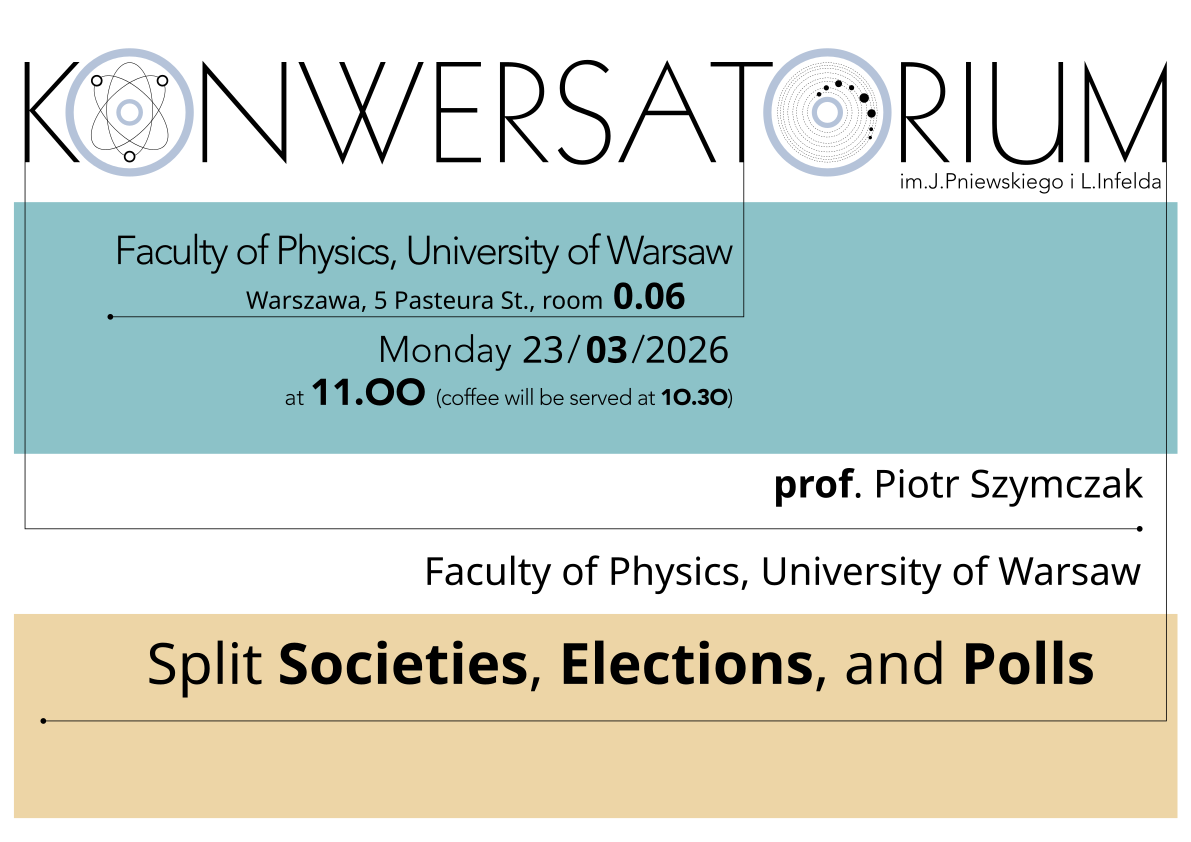
W poniedziałek, 23 marca 2026 r. o godz 11.00 w sali 0.06 odbędzie się Konwersatorium im. Jerzego Pniewskiego i Leopolda Infelda Wydziału Fizyki UW.
Wykład zatytułowany:
"Split Societies, Elections, and Polls"
wygłosi
prof. Piotr Szymczak, Wydział Fizyki UW. .
W wielu przypadkach uczestnicy wyborów muszą poprzez głosowanie wybrać jedną z dwóch możliwości. Okazuje się, że sytuację tę można zaskakująco dobrze opisać posługując się modelem inspirowanym modelem Isinga stosowanym w fizyce materii skondensowanej do opisu oddziaływań magnetycznych między sąsiadującymi spinami.
Wykład odbędzie się w języku angielskim.
Przed Konwersatorium, od godz. 10.30, zapraszamy na nieformalne dyskusje przy kawie i ciastkach w holu przed salą 0.06.
Terminy Konwersatoriów w semestrze letnim 2025/2026 są następujące:
23 marca
27 kwietnia
25 maja
8 czerwca
Zapraszamy i pozdrawiamy
Barbara Badełek
Jan Chwedeńczuk
Jan Suffczyński
Abstract:
"Split Societies, Elections, and Polls"
prof. Piotr Szymczak, Faculty of Physics, Univeristy of Warsaw
In modern democracies, the outcomes of elections and referendums are often strikingly close to evenly split. To explain this phenomenon, we propose a simple model of binary voting inspired by the Ising model. Voters are represented as binary spins, with ferromagnetic coupling between neighbors and an additional weak antiferromagnetic coupling to aggregated opinion polls. The model exhibits a distinct split society phase, whose features resemble those observed in real-world elections: the electorate spontaneously divides into two spatially coherent domains with opposing views; overall support hovers around 50/50; and the interface between domains tends to align with geographic or historical boundaries—such as city edges, natural barriers, or former national borders—where neighbor coupling is weaker. We analyze the physical properties of this phase and identify the conditions under which it emerges. By comparing the modelwith empirical results from binary elections in various countries, we estimate the relevant parameters governing system behavior.
Finally, we examine an alternative coupling mechanism to opinion polls based on self-regulated voter engagement. In this variant, supporters of the leading candidate become less active and less likely to persuade others, while those backing the trailing candidate become increasingly mobilized—tending to equalize public support over time. This mechanism also introduces feedback from polling and can stabilize the system near a 50/50 equilibrium. From a physics perspective, it corresponds to a non-reversible Ising-like model with dynamically evolving couplings.