

Konwersatorium im. Jerzego Pniewskiego i Leopolda Infelda
2026-06-07

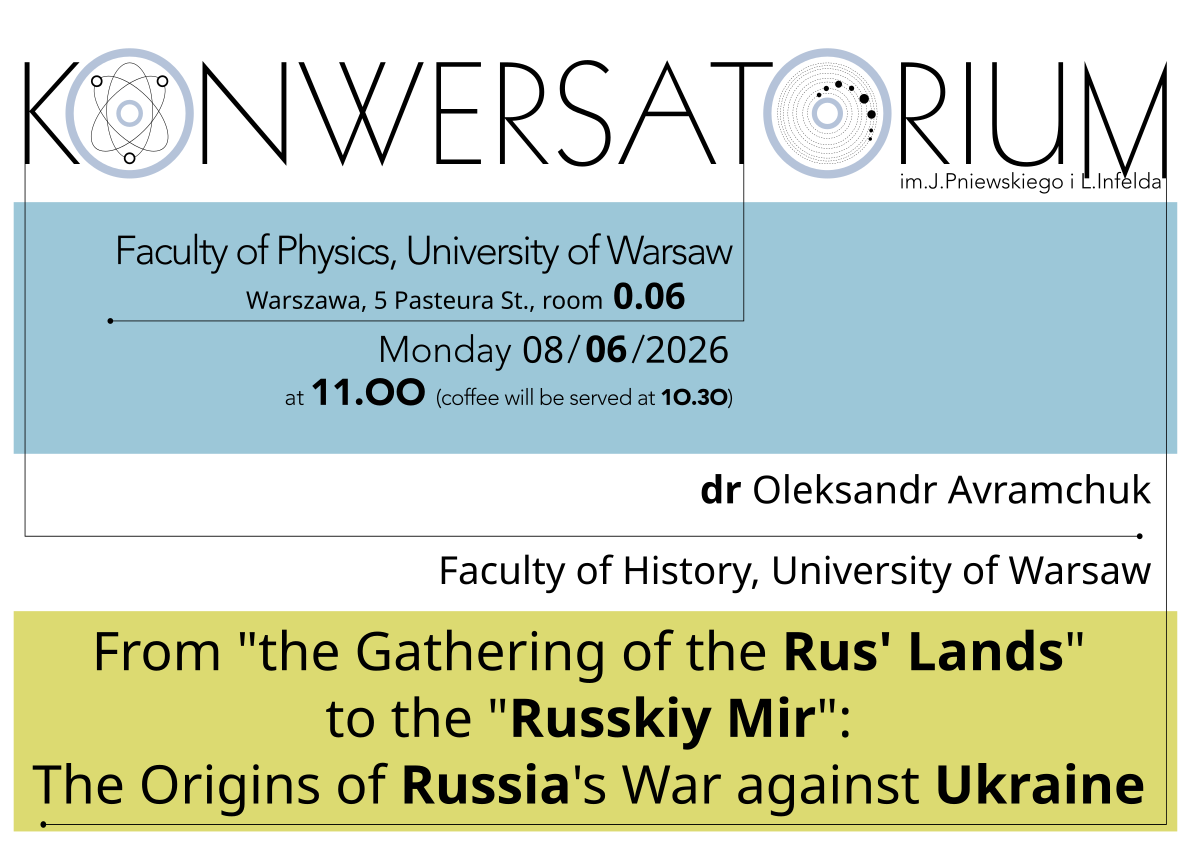
W poniedziałek, 8 czerwca 2026 r. o godz 11.00 w sali 0.06 odbędzie się ostatnie w tym roku akadamieckim Konwersatorium im. Jerzego Pniewskiego i Leopolda Infelda Wydziału Fizyki UW.
Wykład zatytułowany:
"From “the Gathering of the Rus’ Lands” to the “Russkiy Mir”: The Origins of Russia’s War against Ukraine"
wygłosi
dr Oleksandr Avramchuk Faculty of History, University of Warsaw.
Podczas wykładu przyjrzymy się głębokim przyczynom wojny Rosji przeciwko Ukrainie.
Wykład odbędzie się w języku angielskim.
Przed Konwersatorium, od godz. 10.30, zapraszamy na nieformalne dyskusje przy kawie i ciastkach w holu przed salą 0.06.
Kolejne, ostatnie w tym roku akademickim, Konwersatorium odbędzie się w dniu 8 czerwca 2026.
Zapraszamy i pozdrawiamy
Barbara Badełek
Jan Chwedeńczuk
Jan Suffczyński
Abstract:
"From “the Gathering of the Rus’ Lands” to the “Russkiy Mir”: TheOrigins of Russia’s War against Ukraine"
Dr Oleksandr Avramchuk Faculty of History, University of Warsaw
In the summer of 2021, a long article by Vladimir Putin on the “historical unity of Russians and Ukrainians” appeared on the Kremlin website. It was not a text written only for historians or only for Russian readers. A few months later, Russian troops were already massed along Ukraine’s borders. To understand the origins of Russia’s aggression against Ukraine, wemust also ask about history – or, more precisely, about what Russian elites call history. This lecture will examine why Ukraine occupies such a special place in the Russian political imagination. Why does Ukraine appear in Putin’s speeches not as an ordinary neighbouring state, but as part of an allegedly “lost” Russian whole? Where did the belief comefrom that Ukrainians and Russians are “one people,” that Ukrainian statehood is artificial, and that Ukrainian distinctiveness was invented or sustained by external enemies – Poland, Austria-Hungary, Germany, the United States, or NATO? To answer these questions, we will go back to the Muscovite idea of the “gathering of the Rus’ lands,” the nineteenth-century concept of the “triune Russian nation,” the Soviet view of Ukraine, and the contemporary ideology of the Russkiy Mir. Poland will receive particular attention as well: in the Russian imagination, it has often been portrayed as a force supposedly seeking to “tear” Ukraine away from its natural bond with Russia.
Dr. Oleksandr Avramchuk – historian and assistant professor in the Department of History at the University of Warsaw. His research focuses on the modern history of Central and Eastern Europe, with a particular emphasis on Polish-Ukrainian relations, the intellectual history of the region, Cold War diplomacy, and its aftermath after 1991. His researchalso addresses the issue of Soviet Ukraine, analyzing its relations with both the West and the center of power in Moscow. Author of the books The Republic of Scholars. The Emergence of Ukrainian Studies and thePolish-Ukrainian Dialogue Among Historians in the United States, 1939–1991 (Warsaw: Center for Eastern European Studies, University of Warsaw, 2024) and Building the Republic of the Spirit. A History of the Fulbright Program in Poland, 1945–2020 (Warsaw: PWN Scientific Publishing House, 2024). Creator of the Ukrainian-language historical podcast “Without a Declaration of War.”