


Prof. Gang-Ding Peng to Speak at the Photonics Research Network Seminar
2026-10-27
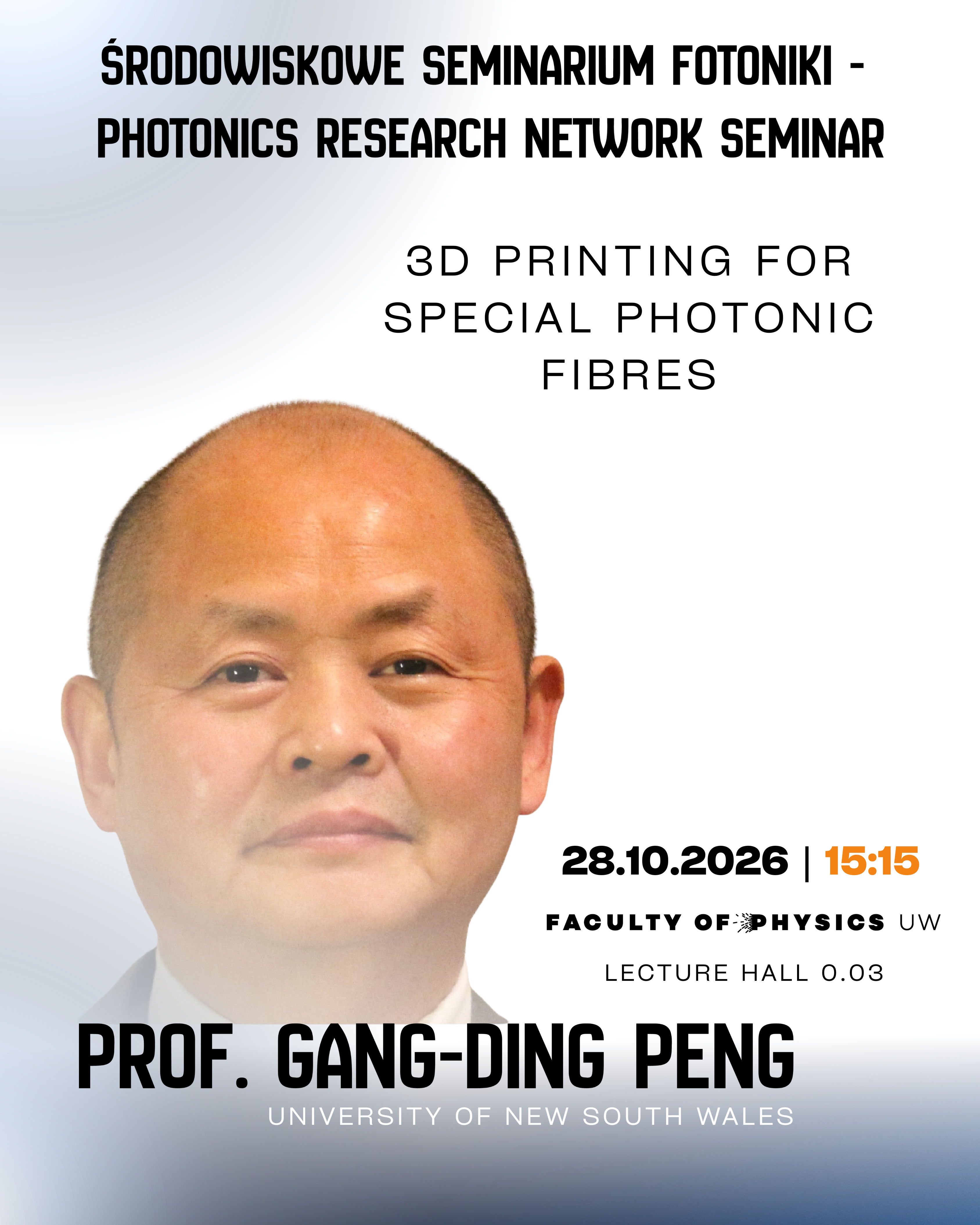
On 28 October 2026, another event in the Photonics Research Network Seminar series will take place. The seminars are organised by the Faculty of Physics at the University of Warsaw and the UW Centre of Excellence for Structured Optical Fibres and Applications (CD SOWA), in collaboration with the Polish Chapter of the IEEE Photonics Society (Institute of Electrical and Electronics Engineers) and the Photonics Society of Poland. The event is aimed at researchers, students and industry representatives, offering an opportunity to learn about the latest advances in photonics. The guest speaker will be Prof. Gang-Ding Peng from the University of New South Wales (UNSW Sydney), Australia, who will deliver a lecture entitled “3D Printing for Special Photonic Fibres.”
The seminars are held monthly, on Wednesdays, and last approximately one hour. Each session features a presentation by a recognised expert in a specific research field, followed by a networking session where participants can exchange ideas and experiences, engage in discussions and establish new collaborations.
The next seminar will take place on 28 October 2026 at 3:15 p.m. in Lecture Hall 0.03 at the Faculty of Physics, University of Warsaw. Prof. Gang-Ding Peng will present his lecture, “3D Printing for Special Photonic Fibres.”
Recent advances in the fabrication of nanosilica-based materials are opening up new possibilities for designing and manufacturing specialised optical fibres with customised properties. The talk will focus on the use of 3D printing technologies to produce silica optical fibres. Prof. Peng will discuss the key technical aspects and fabrication methods involved, present the latest research developments, and explore the remaining challenges and future opportunities for applications in photonics and fibre-optic technologies.
Prof. Gang-Ding Peng is a distinguished expert in photonics and optical fibre technologies who has been affiliated with the University of New South Wales (UNSW Sydney), Australia, since 1991. He graduated with a bachelor's degree in physics from Fudan University in Shanghai in 1982, followed by a master's degree in physics in 1984 and a PhD in electronic engineering in 1987, both from Shanghai Jiao Tong University. From 1988 to 1991, he held a postdoctoral position at the Optical Sciences Centre at the Australian National University in Canberra. Between 1992 and 1996, he was a recipient of a Queen Elizabeth II Fellowship. He is currently a professor at UNSW Sydney, where he conducts research within the Photonics and Optical Communications Group (POCG), part of the School of Electrical Engineering & Telecommunications at the Faculty of Engineering.
His research interests include optical fibres and fibre-optic devices, optical waveguides, fibre-optic sensors and nonlinear optics. He is an Honorary Fellow and Life Fellow of two leading scientific organisations: Optica (formerly the Optical Society of America, OSA) and SPIE (the Society of Photo-Optical Instrumentation Engineers), an international society dedicated to optics and photonics.
Admission is free. Everyone is welcome!